


Recommended list of 50 profitable virtual assistant business ideas, niche services, income potential, required skills, and practical tips to build a successful VA business from anywhere.
The virtual assistant (VA) industry has evolved far beyond managing calendars and responding to emails.
Today, businesses of every size rely on virtual assistants to streamline operations, support customers, manage marketing, coordinate projects, and even implement AI-powered workflows.
As remote work continues to expand, organizations are increasingly hiring specialized VAs instead of full-time, in-house employees, creating countless opportunities for aspiring entrepreneurs.
The source list identifies 50 VA business ideas spanning traditional administrative services, industry-specific specialties, AI-powered solutions, and agency models.
Whether you’re looking for a side hustle, a freelance career, or the foundation for a scalable agency, there’s never been a better time to start a virtual assistant business. The key is no longer offering “everything.” Instead, successful virtual assistants choose a niche, develop expertise, build efficient systems, and deliver measurable value to clients.
This guide explores 50 profitable virtual assistant business ideas, explains who each niche is best suited for, outlines the skills you’ll need, and helps you choose a business model that aligns with your goals.
In this guide, you’ll learn:
- 50 profitable virtual assistant business ideas
- The best virtual assistant niches for beginners
- High-income virtual assistant specializations
- Industry-specific VA opportunities
- AI-powered virtual assistant business models
- How to choose the right niche
- Income potential for different VA businesses
- How to start and grow a successful virtual assistant business
Go to a Section
- Why Start a Virtual Assistant Business?
- How to Choose the Right Virtual Assistant Business
- Administrative Virtual Assistant Business Ideas (1–10)
- Marketing & Creative Virtual Assistant Business Ideas (11–20)
- Sales & Business Growth Virtual Assistant Business Ideas (21–30)
- Industry-Specific Virtual Assistant Business Ideas (31–45)
- AI & Technology Virtual Assistant Business Ideas (46–50)
- Premium VA Business Models
- How Much Can a Virtual Assistant Business Make?
- How to Start Your Virtual Assistant Business
- Frequently Asked Questions
Why Start a Virtual Assistant Business?
The demand for virtual assistants has grown rapidly as businesses embrace remote work, automation, and flexible staffing. Rather than hiring full-time employees for every operational task, companies increasingly outsource specialized work to skilled professionals who can deliver results from anywhere.
A virtual assistant business offers several advantages:
- Low startup costs
- Flexible working hours
- Global client opportunities
- Recurring monthly income
- Ability to specialize
- Potential to build an agency
- Opportunity to combine AI with human expertise
The most successful VAs don’t compete on price—they compete on expertise.
How to Choose the Right Virtual Assistant Business
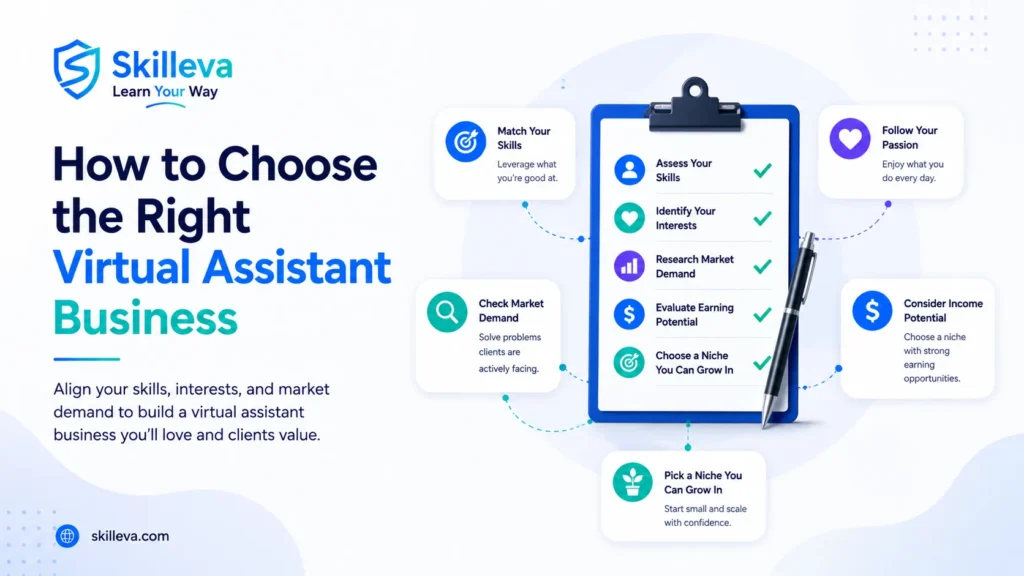
Not every virtual assistant niche is the right fit. Before choosing one, consider several important factors.
| Factor | Questions to Ask Yourself |
|---|---|
| Skills | What tasks do I already perform well? |
| Experience | Which industries do I understand? |
| Demand | Are businesses actively hiring for this service? |
| Income | Can this niche support my financial goals? |
| Competition | How can I differentiate myself? |
| Scalability | Could I eventually build an agency? |
| AI Impact | Will AI enhance my work or replace parts of it? |
Tips for Choosing the Right Niche
Start with your existing strengths.
If you’ve worked in administration, customer service, marketing, bookkeeping, healthcare, or project management, you already possess valuable skills that businesses are willing to pay for.
Focus on solving business problems.
Clients don’t hire virtual assistants because they want a VA. They hire VAs because they need help reducing workload, increasing efficiency, generating leads, or improving customer experience.
Consider long-term growth.
Some services naturally scale into agencies or consulting businesses, while others remain primarily freelance opportunities.
Administrative Virtual Assistant Business Ideas
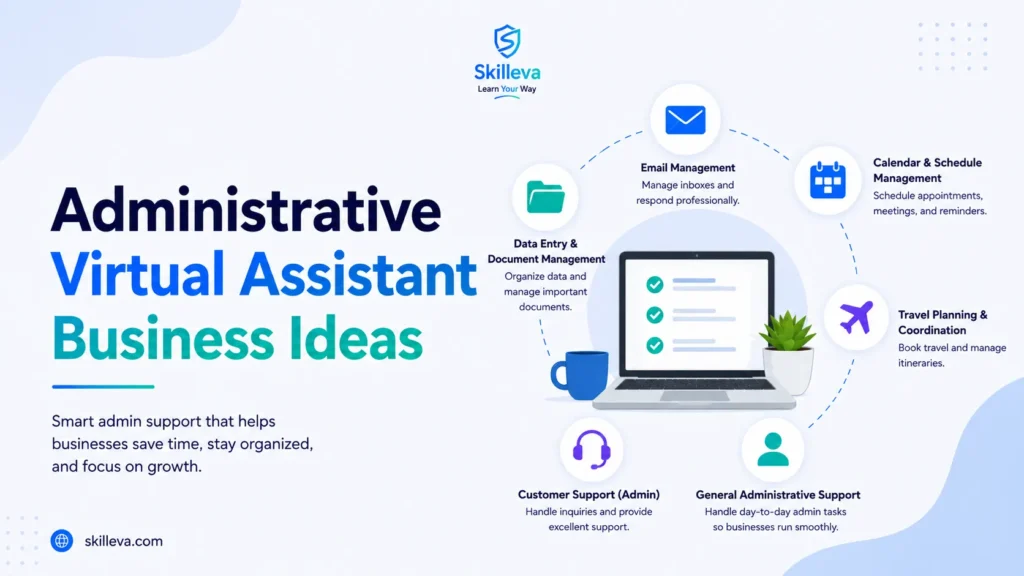
Administrative virtual assistants form the foundation of the VA industry. These services are needed by entrepreneurs, startups, consultants, executives, and growing businesses across nearly every sector.
1. General Virtual Assistant Agency
One of the most versatile business models is building a general virtual assistant agency that provides administrative support such as email management, scheduling, document preparation, travel planning, research, and data entry. The source identifies this as its top recommendation and notes typical pricing ranging from hourly rates to agency-scale annual revenue.
Typical Services
- Email management
- Calendar management
- Scheduling meetings
- Internet research
- File organization
- Customer communication
- Data entry
- Administrative support
Ideal Clients
- Entrepreneurs
- Coaches
- Small businesses
- Consultants
- Agencies
Income Potential
High for agency owners due to recurring monthly retainers and the ability to hire additional VAs.
Skills Needed
- Communication
- Organization
- Time management
- Problem-solving
- Professional writing
Essential Tools
- Google Workspace
- Microsoft 365
- ClickUp
- Trello
- Calendly
- Slack
- Zoom
Best For
Beginners looking to enter the virtual assistant industry.
2. Executive Virtual Assistant
Executive virtual assistants support CEOs, founders, directors, and senior executives. Unlike general VAs, executive assistants handle more complex scheduling, confidential communication, strategic planning, and high-level coordination. The source positions this as a premium service.
Typical Responsibilities
- Executive calendar management
- Travel coordination
- Meeting preparation
- Expense reporting
- Executive correspondence
- Board meeting support
Why It’s Profitable
Executives value reliability, discretion, and proactive problem-solving, allowing experienced professionals to command premium rates.
Best For
Experienced administrative professionals.
3. Email Management Specialist
Many entrepreneurs spend hours every day managing overflowing inboxes. An Email Management VA helps organize communications, prioritize important messages, draft responses, and maintain “Inbox Zero.”
Responsibilities
- Inbox organization
- Email filtering
- Response drafting
- Follow-ups
- Newsletter management
- Customer inquiries
Ideal Clients
- Coaches
- Consultants
- Business owners
- Agencies
Skills
- Excellent written communication
- Organization
- Attention to detail
4. Calendar & Scheduling Virtual Assistant
Businesses lose valuable time coordinating meetings. Calendar management specialists simplify scheduling while avoiding conflicts and improving productivity.
Services
- Meeting scheduling
- Appointment reminders
- Time zone coordination
- Event planning
- Calendar optimization
Best Clients
- Consultants
- Medical professionals
- Coaches
- Executives
5. Data Entry & Administrative Support
Although data entry is one of the most accessible virtual assistant services, businesses continue to outsource tasks such as CRM updates, spreadsheet management, and document digitization. The source includes data entry among the core administrative business ideas.
Common Tasks
- CRM updates
- Spreadsheet organization
- Database maintenance
- Document formatting
- Record management
Skills
- Accuracy
- Speed
- Attention to detail
6. Research Virtual Assistant
Research virtual assistants collect, organize, and summarize information for businesses.
Projects may include:
- Competitor research
- Market research
- Product research
- Lead research
- Industry analysis
Businesses value research assistants because they save decision-makers significant time.
7. Travel Planning Virtual Assistant
Busy professionals often outsource travel planning to experienced VAs.
Typical services include:
- Flight booking
- Hotel reservations
- Itinerary creation
- Visa documentation
- Conference planning
Attention to detail is critical in this niche.
8. Personal Concierge Virtual Assistant
Personal concierge VAs help high-net-worth individuals and busy professionals manage personal responsibilities alongside business obligations.
Services may include:
- Personal appointments
- Gift purchasing
- Restaurant reservations
- Household coordination
- Lifestyle management
This premium niche often develops into long-term client relationships.
9. Project Management Virtual Assistant
As businesses adopt tools like ClickUp, Asana, Monday.com, and Trello, demand continues to grow for virtual assistants who can coordinate projects, monitor deadlines, and keep teams aligned. The source identifies project management as a dedicated VA specialization.
Responsibilities
- Project tracking
- Task assignment
- Workflow management
- Meeting coordination
- Reporting
Required Skills
- Leadership
- Communication
- Organization
- Process improvement
10. Virtual Operations Manager
Operations managers go beyond administrative support by improving business systems and coordinating teams. This is one of the highest-value virtual assistant specializations because it directly impacts business growth.
Responsibilities include:
- Process documentation
- SOP creation
- Team coordination
- Workflow optimization
- Performance reporting
- Business systems improvement
This niche is ideal for experienced VAs looking to transition into consulting or operations leadership.
Marketing & Creative Virtual Assistant Business Ideas
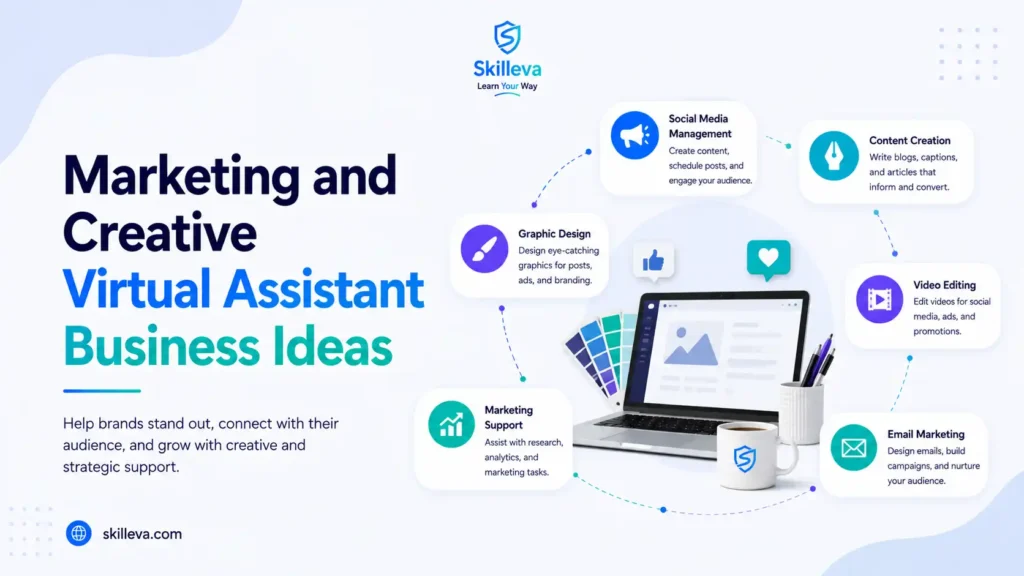
Marketing and creative virtual assistants help businesses attract customers, strengthen their online presence, and grow their brands. Unlike traditional administrative roles, these specializations combine creativity, communication, and digital marketing skills.
If you enjoy writing, designing, creating content, or working with marketing tools, these niches offer excellent long-term growth opportunities.
11. Social Media Virtual Assistant
Social media has become an essential marketing channel for businesses, but maintaining multiple platforms consistently requires time and expertise. A Social Media Virtual Assistant helps businesses plan, publish, monitor, and optimize their social media presence. The source identifies this as one of the top virtual assistant business ideas.
Typical Services
- Content scheduling
- Caption writing
- Hashtag research
- Community engagement
- Analytics reporting
- Content calendar management
Ideal Clients
- Small businesses
- Coaches
- Content creators
- Agencies
- E-commerce stores
Skills Needed
- Copywriting
- Social media strategy
- Content planning
- Basic graphic design
- Analytics interpretation
Recommended Tools
- Meta Business Suite
- Buffer
- Hootsuite
- Canva
- Metricool
- Later
Best For
Creative individuals who enjoy building online communities.
12. Content Writing Virtual Assistant
Businesses need consistent, high-quality content to attract customers through search engines, email marketing, and social media. Content Writing Virtual Assistants create valuable written content that supports marketing and sales efforts. The source includes blog writing, email copy, and SEO content among the services offered in this niche.
Services
- Blog articles
- Website copy
- Email newsletters
- Landing pages
- Product descriptions
- Case studies
Income Potential
Writers who specialize in SEO or technical industries often command higher rates than general writers.
Skills
- Research
- Grammar
- Storytelling
- SEO fundamentals
13. SEO Virtual Assistant
Search Engine Optimization (SEO) helps businesses improve their visibility in search results. SEO Virtual Assistants support marketing teams by conducting keyword research, optimizing website content, and monitoring search performance. The source identifies SEO as a dedicated VA specialization.
Common Responsibilities
- Keyword research
- On-page optimization
- Meta title creation
- Internal linking
- Content optimization
- Basic technical SEO
- Competitor research
Tools
- Google Search Console
- Google Analytics
- Ahrefs
- Semrush
- Ubersuggest
Why It’s Valuable
SEO generates long-term traffic, making it one of the most sought-after digital marketing skills.
14. Podcast Production Virtual Assistant
Podcasting continues to grow as a marketing channel for businesses, educators, and creators. Many hosts outsource production tasks so they can focus on creating content.
The source lists podcast production among the profitable VA opportunities.
Responsibilities
- Episode scheduling
- Guest coordination
- Show notes
- Audio publishing
- Social media promotion
- Podcast distribution
Skills
- Organization
- Communication
- Basic audio editing
- Content marketing
Recommended Tools
- Riverside
- Descript
- Spotify for Creators
- Buzzsprout
15. Graphic Design Virtual Assistant
Not every business needs a full-time designer, but almost every business needs visual content.
Graphic Design Virtual Assistants create professional graphics that strengthen a company’s brand identity.
Services
- Social media graphics
- Presentations
- Marketing materials
- Infographics
- Lead magnets
- Digital advertisements
Skills
- Canva
- Adobe Express
- Photoshop (optional)
- Branding fundamentals
Best Clients
- Coaches
- Small businesses
- Agencies
- Online educators
16. Video Editing Virtual Assistant
Short-form video has transformed digital marketing. Businesses increasingly hire video editing VAs to turn raw footage into polished content for YouTube, Instagram, TikTok, and LinkedIn. The source includes video editing as a dedicated business idea.
Services
- Short-form videos
- YouTube editing
- Reels
- Captions
- Thumbnails
- Basic animations
Recommended Software
- CapCut
- Premiere Pro
- DaVinci Resolve
- Descript
Best For
Creative individuals interested in video production.
17. Email Marketing Virtual Assistant
Email marketing remains one of the highest-return marketing channels.
Businesses hire Email Marketing Virtual Assistants to build campaigns that nurture leads and strengthen customer relationships.
Responsibilities
- Newsletter creation
- Campaign setup
- List segmentation
- Automation
- Performance reporting
Platforms
- Mailchimp
- ConvertKit
- Brevo
- ActiveCampaign
- MailerLite
18. Copywriting Virtual Assistant
Copywriting differs from content writing because its primary goal is persuasion rather than education.
Copywriting VAs help businesses increase conversions through compelling messaging.
Services
- Sales pages
- Landing pages
- Product descriptions
- Ad copy
- Email campaigns
- Website copy
Ideal Clients
- Agencies
- Coaches
- SaaS businesses
- E-commerce brands
19. Brand Management Virtual Assistant
A consistent brand builds trust.
Brand Management Virtual Assistants ensure that every customer touchpoint reflects a company’s voice, messaging, and visual identity.
Responsibilities
- Brand consistency
- Content review
- Asset organization
- Style guide management
- Marketing coordination
Skills
- Communication
- Organization
- Attention to detail
- Marketing knowledge
20. Content Repurposing Virtual Assistant
Creating content takes time. Repurposing multiplies its value.
Content Repurposing Virtual Assistants transform one piece of content into multiple formats for different platforms.
For example:
One podcast episode becomes:
- Blog article
- LinkedIn post
- Instagram carousel
- Email newsletter
- YouTube Shorts
- X thread
- Facebook post
Why Businesses Love This Service
Instead of constantly creating new content, businesses maximize the value of every piece they already produce.
Skills
- Writing
- Basic design
- Video editing
- Content strategy
- AI-assisted workflows
Recommended Tools
- ChatGPT
- Claude
- Canva
- CapCut
- Descript
Which Marketing VA Niche Is Best?
| Niche | Difficulty | Income Potential | Demand |
|---|---|---|---|
| Social Media VA | Beginner | High | Very High |
| Content Writing VA | Beginner | High | High |
| SEO VA | Intermediate | Very High | Very High |
| Podcast VA | Intermediate | High | Growing |
| Graphic Design VA | Beginner | High | High |
| Video Editing VA | Intermediate | Very High | Very High |
| Email Marketing VA | Intermediate | Very High | High |
| Copywriting VA | Intermediate | Very High | Very High |
| Brand Management VA | Advanced | Very High | Growing |
| Content Repurposing VA | Beginner | High | Rapidly Growing |
Marketing and creative virtual assistant businesses offer excellent opportunities for professionals who enjoy combining creativity with strategy.
Rather than trying to master every service, focus on one or two complementary specialties, such as SEO and content writing, social media and graphic design, or video editing and content repurposing, and build a reputation for delivering measurable results.
Sales & Business Growth Virtual Assistant Business Ideas
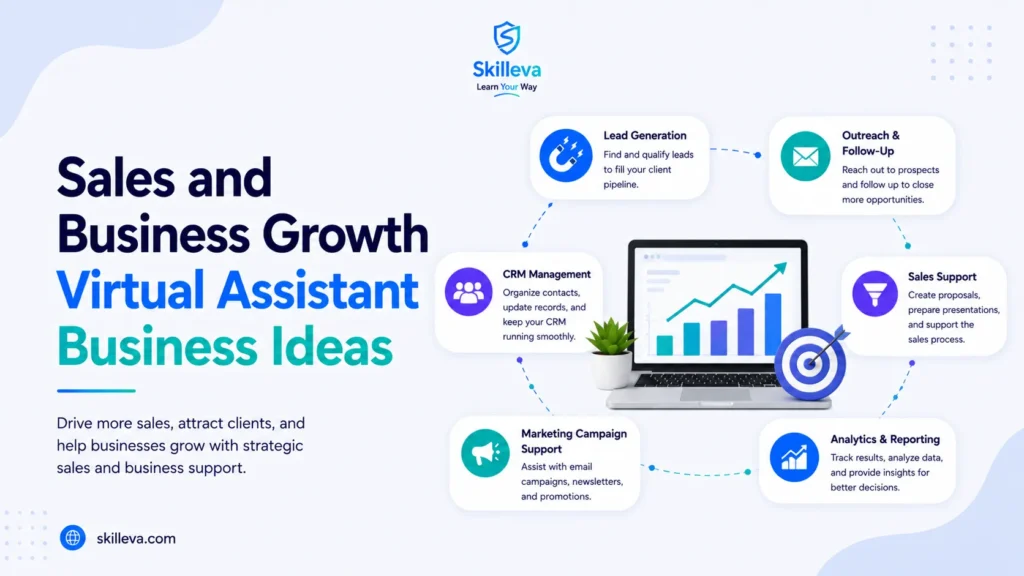
Virtual assistants are no longer limited to administrative support.
Today, many businesses hire VAs to help them generate leads, improve customer relationships, increase sales, and streamline revenue-generating processes.
These niches typically command higher rates because they directly contribute to business growth.
21. Virtual Assistant for Coaches & Consultants
Coaches and consultants often juggle client delivery, content creation, marketing, and administrative work. A specialized VA helps them stay organized and focus on serving clients. The source highlights client onboarding, course management, and funnel support as common responsibilities.
Typical Services
- Client onboarding
- Course administration
- CRM management
- Calendar management
- Email communication
- Webinar support
- Community management
Ideal Clients
- Business coaches
- Career coaches
- Executive coaches
- Marketing consultants
- Financial consultants
Best Tools
- Kajabi
- Teachable
- Thinkific
- GoHighLevel
- Zoom
22. Lead Generation Virtual Assistant
Businesses constantly need qualified leads.
Lead Generation Virtual Assistants research prospects, build targeted contact lists, verify information, and prepare businesses for successful outreach.
The source identifies lead generation as a dedicated virtual assistant specialization.
Services
- Prospect research
- List building
- CRM updates
- Contact verification
- Lead enrichment
- LinkedIn prospecting
Recommended Tools
- Apollo.io
- LinkedIn Sales Navigator
- Clay
- ZoomInfo
- Google Sheets
Why Businesses Hire This VA
Without quality leads, sales teams struggle to grow revenue.
23. Sales Outreach Virtual Assistant
Finding leads is only the beginning.
Sales Outreach Virtual Assistants help businesses start conversations through email campaigns, LinkedIn outreach, and follow-up sequences. The source includes prospect research, email sequences, and LinkedIn outreach as core services.
Responsibilities
- Cold email campaigns
- LinkedIn outreach
- Follow-up emails
- CRM tracking
- Appointment booking
- Campaign reporting
Skills
- Persuasive writing
- CRM management
- Relationship building
- Sales communication
24. Customer Service Virtual Assistant
Customer experience is one of the biggest competitive advantages for businesses.
Customer Service Virtual Assistants provide professional support across multiple communication channels while maintaining customer satisfaction.
The source highlights email, chat, and phone support as key responsibilities.
Services
- Live chat
- Email support
- Phone support
- Order assistance
- Complaint resolution
- Knowledge base updates
Best Clients
- E-commerce businesses
- SaaS companies
- Agencies
- Healthcare providers
Recommended Tools
- Zendesk
- Freshdesk
- Intercom
- HubSpot
- Gorgias
25. Appointment Setting Virtual Assistant
Appointment setters bridge the gap between marketing and sales.
Instead of closing deals themselves, they qualify prospects and schedule meetings for business owners or sales representatives.
Typical Responsibilities
- Qualifying leads
- Scheduling discovery calls
- CRM updates
- Calendar coordination
- Reminder messages
- Follow-up communication
Ideal Clients
- Agencies
- Consultants
- Financial advisors
- Insurance professionals
- Real estate agents
Best Sales & Growth Niches
| Niche | Difficulty | Income Potential |
|---|---|---|
| Coach & Consultant VA | Beginner | High |
| Lead Generation VA | Intermediate | Very High |
| Sales Outreach VA | Intermediate | Very High |
| Customer Service VA | Beginner | High |
| Appointment Setter VA | Beginner | High |
E-commerce Virtual Assistant Business Ideas
Online stores require constant attention.
Product listings, inventory management, customer support, fulfillment, and marketing all create opportunities for specialized virtual assistants.
26. Shopify Virtual Assistant
Shopify powers millions of online stores worldwide.
Shopify Virtual Assistants help store owners manage daily operations efficiently.
Responsibilities
- Product uploads
- Collection management
- Customer support
- Discount setup
- Store maintenance
- Order management
Skills
- Shopify Admin
- Product research
- Customer communication
27. Amazon Seller Virtual Assistant
Amazon businesses require specialized support.
The source lists listing optimization, PPC management, and inventory tracking among the responsibilities of Amazon Seller VAs.
Typical Services
- Product listing optimization
- Keyword research
- Inventory monitoring
- Customer messages
- PPC support
- Competitor analysis
Recommended Tools
- Helium 10
- Jungle Scout
- Seller Central
28. WooCommerce Virtual Assistant
WooCommerce remains one of the world’s most popular e-commerce platforms.
WooCommerce VAs assist businesses with:
- Product uploads
- Pricing updates
- Inventory management
- Coupon creation
- Customer support
- Basic WordPress maintenance
Ideal Clients
- Small businesses
- Digital product creators
- Local retailers
29. Product Listing & Inventory Virtual Assistant
Large online stores constantly add and update products.
This specialization focuses on maintaining accurate product information.
Responsibilities
- Product uploads
- SKU management
- Inventory tracking
- Product descriptions
- Image optimization
- Price updates
Skills
- Attention to detail
- Spreadsheet management
- Organization
30. E-commerce Customer Experience Virtual Assistant
Beyond fulfilling orders, businesses need professionals who create exceptional customer experiences.
Responsibilities include:
- Customer inquiries
- Returns
- Refunds
- Order tracking
- Loyalty program support
- Review management
Excellent customer service leads to repeat purchases and stronger brand loyalty.
Best E-commerce Niches
| Niche | Difficulty | Income Potential |
|---|---|---|
| Shopify VA | Beginner | High |
| Amazon VA | Intermediate | Very High |
| WooCommerce VA | Beginner | High |
| Product Listing VA | Beginner | Moderate |
| Customer Experience VA | Beginner | High |
Choosing Between Sales and E-commerce
If you enjoy building relationships, generating leads, and helping businesses grow, a Sales & Business Growth VA specialization may be the right fit.
If you prefer working with online stores, products, and customer operations, an E-commerce VA niche offers stable demand and opportunities to specialize further in platforms such as Shopify, Amazon, or WooCommerce.
Many successful virtual assistants combine these skills. For example, an Amazon VA may also provide customer service, while a Shopify VA might expand into email marketing or conversion optimization, increasing their value and earning potential.
Industry-Specific Virtual Assistant Business Ideas
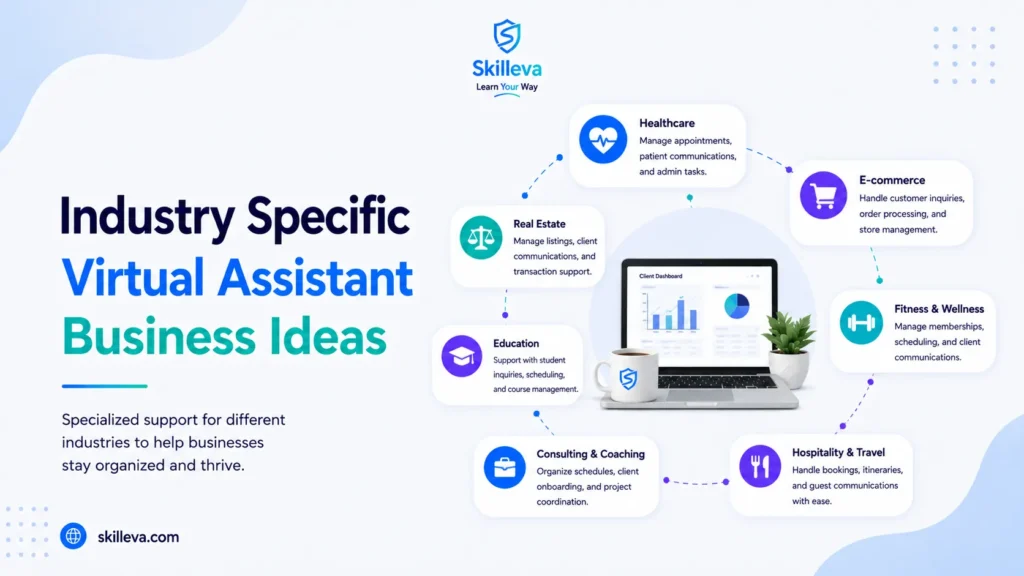
One of the fastest ways to increase your value as a virtual assistant is to specialize in a particular industry. Instead of serving every type of client, industry-specific VAs develop expertise in a niche, understand common workflows, and become trusted partners rather than general assistants.
Clients are often willing to pay premium rates for professionals who understand their industry, terminology, software, and compliance requirements. The source identifies several high-demand industry-specific virtual assistant opportunities across healthcare, real estate, finance, legal services, and more.
31. Real Estate Virtual Assistant
The real estate industry moves quickly. Agents, brokers, and property investors spend much of their time showing properties, negotiating deals, and meeting clients. A Real Estate Virtual Assistant keeps the business running behind the scenes.
Typical Services
- CRM management
- Listing management
- MLS updates
- Appointment scheduling
- Lead follow-up
- Marketing support
- Transaction coordination
Ideal Clients
- Real estate agents
- Brokers
- Teams
- Property investors
Recommended Tools
- Follow Up Boss
- KVCore
- Zillow
- Dotloop
- DocuSign
Why It’s Profitable
Real estate professionals often require ongoing monthly support, creating stable recurring income.
32. Real Estate Investor Virtual Assistant
Real estate investors have different needs from traditional agents. Their focus is identifying investment opportunities, managing acquisitions, and communicating with sellers.
The source identifies investor support as a specialized niche.
Responsibilities
- Property research
- Skip tracing
- Lead management
- Seller communication
- Comparable sales research
- Appointment scheduling
Best For
VAs interested in investment analysis and property acquisitions.
33. Medical Virtual Assistant
Healthcare providers increasingly rely on virtual assistants to reduce administrative burdens while improving patient experiences.
Medical Virtual Assistants typically support:
- Clinics
- Private practices
- Specialists
- Telehealth providers
Common Services
- Appointment scheduling
- Patient communication
- Insurance verification
- Medical transcription
- Record organization
- Referral coordination
Important Consideration
Healthcare clients often require knowledge of privacy regulations and secure handling of patient information.
34. Dental Virtual Assistant
Dental practices face many of the same administrative challenges as medical clinics.
Dental VAs help practices improve efficiency by managing:
- Appointment scheduling
- Recall reminders
- Insurance coordination
- Patient communication
- Treatment follow-ups
- Administrative documentation
35. Therapist & Mental Health Virtual Assistant
Mental health professionals spend their time supporting clients—not managing paperwork.
Therapist Virtual Assistants assist:
- Counselors
- Therapists
- Psychologists
- Psychiatrists
- Coaches
Services
- Client scheduling
- Intake paperwork
- Calendar management
- Secure communication
- Billing coordination
- Practice administration
Because confidentiality is essential, trust and professionalism are especially valuable in this niche.
36. Legal Virtual Assistant
Law firms generate significant administrative work.
Legal Virtual Assistants support attorneys by helping organize documentation and improve operational efficiency.
The source identifies legal services as a specialized VA business opportunity.
Typical Responsibilities
- Document preparation
- Calendar management
- Client communication
- Legal research support
- File organization
- Billing assistance
Best Clients
- Solo attorneys
- Small law firms
- Legal consultants
37. Insurance Virtual Assistant
Insurance agencies manage thousands of customer interactions each year.
Insurance Virtual Assistants help streamline:
- Policy administration
- Claims support
- Client communication
- Appointment scheduling
- Document collection
- Renewal reminders
Why Businesses Hire Them
Administrative efficiency allows insurance advisors to focus on selling and serving clients.
38. Bookkeeping Virtual Assistant
Bookkeeping Virtual Assistants support accountants and business owners by organizing financial information.
The source identifies bookkeeping support among its industry-focused business ideas.
Services
- Expense categorization
- Invoice preparation
- Receipt management
- Bank reconciliation support
- Financial record organization
- Accounts receivable tracking
Recommended Software
- QuickBooks Online
- Xero
- Wave
- FreshBooks
Best For
Professionals comfortable working with numbers and financial systems.
39. Financial Advisor Virtual Assistant
Financial advisors spend significant time meeting clients, creating investment plans, and maintaining regulatory documentation.
Virtual assistants provide valuable operational support through:
- Calendar management
- Client onboarding
- Meeting preparation
- CRM updates
- Administrative reporting
- Document organization
40. Property Management Virtual Assistant
Property managers oversee multiple properties, tenants, maintenance requests, and contractors.
Virtual assistants simplify operations by handling:
- Tenant communication
- Maintenance coordination
- Lease documentation
- Vendor scheduling
- Rent reminders
- Administrative reporting
41. Construction Virtual Assistant
Construction companies increasingly use remote administrative professionals to coordinate projects and improve communication.
Responsibilities
- Project scheduling
- Contractor communication
- Document management
- Quote preparation
- Invoice tracking
- Material coordination
Ideal Clients
- Contractors
- Builders
- Construction firms
- Renovation companies
42. Author & Publisher Virtual Assistant
Authors and publishers often operate as small businesses.
Virtual assistants help them manage both creative and administrative tasks.
Services
- Manuscript formatting
- Book launch coordination
- Reader communication
- Newsletter management
- Website updates
- Publishing assistance
Best Clients
- Independent authors
- Publishing consultants
- Book coaches
43. Photographer Virtual Assistant
Photographers spend much of their time editing images and serving clients.
A Photographer Virtual Assistant supports the business by managing:
- Client communication
- Scheduling
- Contracts
- Gallery delivery
- Social media
- Administrative tasks
44. Event Planning Virtual Assistant
Planning events involves coordinating vendors, guests, venues, timelines, and logistics.
Virtual assistants support event planners by handling:
- Registration
- Vendor communication
- Guest management
- Scheduling
- Budget tracking
- Follow-up communication
This niche works well for professionals who enjoy organization and project coordination.
45. Nonprofit Virtual Assistant
Nonprofit organizations often operate with limited budgets and lean teams.
Virtual assistants help maximize impact by providing support in:
- Grant research
- Donor communication
- Volunteer coordination
- Event administration
- Newsletter creation
- Database management
Why It’s Rewarding
Beyond income, this niche allows VAs to contribute to meaningful social causes while developing valuable operational experience.
Comparing Industry-Specific Virtual Assistant Niches
| Industry | Difficulty | Income Potential | Long-Term Demand |
|---|---|---|---|
| Real Estate | Intermediate | High | Very High |
| Real Estate Investing | Intermediate | Very High | High |
| Medical | Advanced | Very High | Very High |
| Dental | Intermediate | High | High |
| Therapy & Mental Health | Intermediate | High | Growing |
| Legal | Advanced | Very High | High |
| Insurance | Intermediate | High | Stable |
| Bookkeeping | Intermediate | Very High | Very High |
| Financial Advisors | Intermediate | High | High |
| Property Management | Intermediate | High | Growing |
| Construction | Beginner–Intermediate | High | Growing |
| Authors & Publishers | Beginner | Moderate | Growing |
| Photography | Beginner | Moderate | Stable |
| Event Planning | Beginner | High | Seasonal |
| Nonprofit | Beginner | Moderate | Stable |
Choosing an Industry to Specialize In
If you’ve previously worked in a specific industry, consider building your virtual assistant business around that experience. Existing knowledge of industry terminology, workflows, and software gives you a competitive advantage and shortens your learning curve.
For example:
- A former receptionist may transition into a Medical or Dental VA.
- Someone with accounting experience could become a Bookkeeping VA.
- A real estate administrator is well positioned to become a Real Estate VA.
- A customer service professional may thrive in Property Management or Insurance support.
Specialization allows you to move beyond being “just another VA” and become a trusted expert within a particular field.
That expertise often leads to higher rates, longer client relationships, and more referrals.
AI & Technology Virtual Assistant Business Ideas
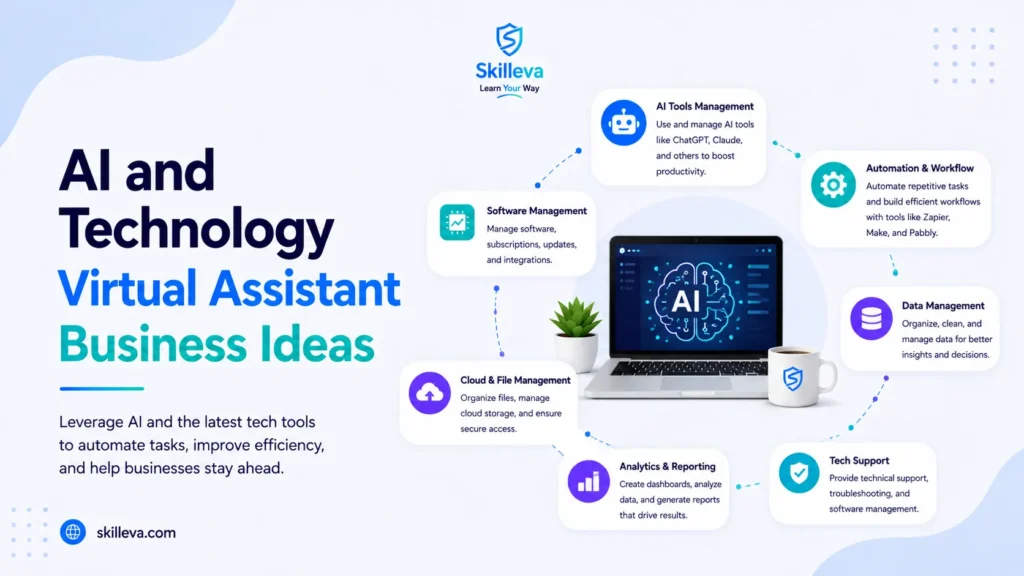
Artificial intelligence is transforming how businesses operate—but it is not eliminating the need for virtual assistants. Instead, it is creating a new generation of professionals who combine AI tools with human judgment, creativity, and business knowledge.
Businesses don’t just need someone who knows how to use AI. They need someone who can integrate AI into their workflows, automate repetitive tasks, improve productivity, and ensure quality outcomes.
The source highlights AI-focused virtual assistant services as some of the fastest-growing business opportunities for modern VAs.
46. AI Workflow Virtual Assistant
Every business has repetitive processes—responding to inquiries, organizing files, updating spreadsheets, or generating reports. An AI Workflow Virtual Assistant identifies these tasks and designs efficient workflows using AI tools.
Typical Services
- Workflow analysis
- AI prompt creation
- Document automation
- AI-assisted research
- Meeting summaries
- Knowledge management
- Productivity optimization
Recommended Tools
- ChatGPT
- Claude
- Gemini
- Microsoft Copilot
- Notion AI
Ideal Clients
- Small businesses
- Consultants
- Agencies
- Startups
- Professional service firms
Why It’s Valuable
Businesses save hours every week by automating repetitive work while maintaining quality through human oversight.
47. AI Chatbot Builder Virtual Assistant
Many businesses want to provide instant customer support without hiring additional staff.
AI Chatbot Builder Virtual Assistants help organizations implement chatbots that answer common questions, qualify leads, and improve customer experiences.
The source identifies chatbot implementation as an emerging specialization.
Typical Responsibilities
- Chatbot setup
- Conversation design
- Knowledge base integration
- FAQ development
- Testing
- Performance monitoring
Recommended Platforms
- ChatGPT
- Intercom
- Tidio
- ManyChat
- Voiceflow
Best Clients
- E-commerce stores
- SaaS companies
- Educational platforms
- Service businesses
48. Automation Specialist Virtual Assistant
Automation Specialists connect business applications so information flows automatically between systems.
Rather than manually copying data from one application to another, businesses automate these processes using integration platforms.
Typical Services
- Workflow automation
- CRM integrations
- Form automations
- Email automation
- Lead routing
- Task automation
- Reporting automation
Popular Tools
- Zapier
- Make
- Pabbly Connect
- Microsoft Power Automate
Example Projects
- Automatically send website leads into a CRM
- Generate invoices after purchases
- Create project tasks from online forms
- Send Slack notifications for new orders
- Automate client onboarding
Income Potential
High. Automation specialists solve measurable business problems and often work on both project-based and recurring engagements.
49. CRM Implementation & Systems Virtual Assistant
Customer Relationship Management (CRM) platforms are central to many businesses, but setting them up correctly requires planning and technical understanding.
A CRM Systems VA helps businesses implement, customize, and maintain their CRM.
Responsibilities
- CRM setup
- Pipeline creation
- Contact migration
- Workflow automation
- Dashboard creation
- User training
Popular Platforms
- HubSpot
- GoHighLevel
- Salesforce
- Zoho CRM
- Pipedrive
Ideal Clients
- Sales teams
- Agencies
- Consultants
- Growing businesses
50. Technical Support & Systems Virtual Assistant
Businesses rely on dozens of digital tools every day. When systems stop working, productivity suffers.
Technical Support Virtual Assistants help organizations maintain and troubleshoot their technology.
Typical Services
- User support
- Software configuration
- Website updates
- Account management
- Basic troubleshooting
- Documentation
- Technology onboarding
Skills Needed
- Problem-solving
- Communication
- Technical curiosity
- Documentation
Recommended Tools
- WordPress
- Google Workspace
- Microsoft 365
- Slack
- Zoom
- Remote support software
Comparing AI & Technology Virtual Assistant Niches
| Niche | Difficulty | Income Potential | Future Demand |
|---|---|---|---|
| AI Workflow VA | Intermediate | Very High | Excellent |
| AI Chatbot Builder | Intermediate | Very High | Excellent |
| Automation Specialist | Advanced | Very High | Excellent |
| CRM Systems VA | Intermediate | Very High | Excellent |
| Technical Support VA | Intermediate | High | Very High |
Premium Virtual Assistant Business Models
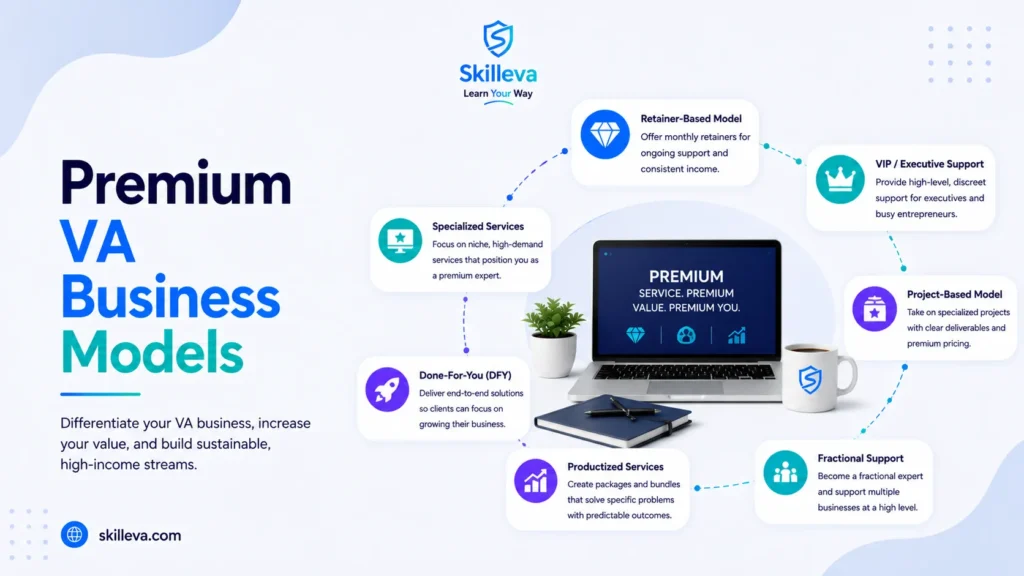
As your experience grows, you don’t have to remain a solo freelancer. Many successful virtual assistants increase their income by changing how they deliver services rather than simply working more hours.
The source includes several scalable business models beyond one-to-one client work.
1. Virtual Assistant Agency
Instead of serving every client yourself, build a team of trained virtual assistants and manage client relationships while your team delivers the work.
Advantages
- Higher earning potential
- Ability to serve more clients
- Recurring monthly revenue
- More scalable than freelancing
Challenges
- Recruiting and training
- Quality assurance
- Team management
- Standard operating procedures (SOPs)
2. White-Label Virtual Assistant Services
Many marketing agencies, consultants, accountants, and software companies need VA services but don’t want to hire internally.
As a white-label provider, you deliver the work while the partner company presents it under their own brand.
This model can create long-term, high-volume partnerships.
3. Subscription-Based VA Services
Instead of charging by the hour, package your services into monthly plans.
For example:
| Plan | Monthly Support |
|---|---|
| Starter | 10 hours |
| Growth | 25 hours |
| Premium | 40+ hours |
Subscription models improve cash flow and provide predictable monthly income.
4. Virtual Assistant Marketplace
Rather than delivering services yourself, create a platform that connects businesses with qualified virtual assistants.
Revenue may come from:
- Membership fees
- Placement fees
- Commission
- Featured listings
This model requires more upfront investment but offers significant long-term scalability.
5. Virtual Assistant Recruitment Service
Many companies struggle to find qualified remote professionals.
A recruitment-focused business helps organizations source, screen, and place virtual assistants.
Services may include:
- Candidate sourcing
- Skills assessments
- Interviews
- Reference checks
- Placement support
6. Virtual Assistant Training Business
Experienced VAs can diversify their income by teaching others.
Possible offerings include:
- Online courses
- Live workshops
- Coaching
- Digital guides
- Certification programs
- Mentorship
This business model creates additional income while strengthening your authority within the industry.
7. Productivity & Operations Consulting
Some businesses don’t just need someone to complete tasks—they need someone to improve how the business operates.
Consulting services may include:
- Workflow optimization
- SOP development
- Team productivity
- Systems implementation
- Process documentation
- Operational audits
8. AI + Human Hybrid Services
The future belongs to professionals who combine AI efficiency with human expertise.
Rather than positioning yourself as someone who competes with AI, position yourself as the expert who helps businesses use AI effectively while maintaining quality, creativity, and strategic thinking.
When Should You Transition from Freelancer to Agency?
Consider expanding beyond solo freelancing when:
- You’re consistently turning away work.
- Existing clients ask for additional services.
- You have documented systems and SOPs.
- Revenue is stable enough to support contractors or employees.
- You enjoy managing people as much as completing tasks.
Building an agency isn’t the right path for everyone, but it can significantly increase your impact and earning potential if you’re ready to lead a team.
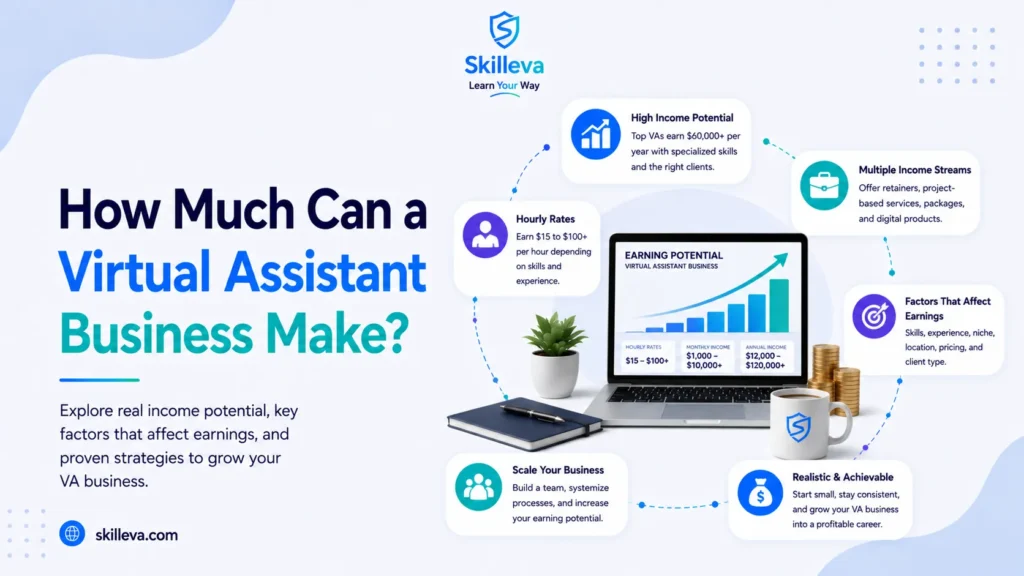
How Much Can a Virtual Assistant Business Make?
One of the first questions aspiring virtual assistants ask is:
“How much can I realistically earn?”
The honest answer is that your income depends less on your job title and more on your:
- Skills,
- Specialization,
- Experience,
- Pricing strategy, and
- Ability to deliver measurable results.
A general virtual assistant may start with modest rates while building experience.
However, as you develop specialized skills in areas such as operations management, automation, CRM systems, bookkeeping, or AI workflows, you can significantly increase your earning potential.
The source material also notes that many of these business ideas can evolve into agencies or scalable service businesses, creating opportunities beyond individual client work.
What Determines Your Income?
Several factors influence how much your virtual assistant business can generate.
1. Your Niche
Specialized services generally command higher rates than general administrative work.
For example:
- Executive support
- CRM implementation
- Automation
- Operations management
- Bookkeeping
- AI workflows
typically earn more than basic data entry.
2. Your Experience
Businesses pay more for professionals who can work independently, anticipate problems, and improve processes rather than simply completing assigned tasks.
Experience also reduces onboarding time, making you more valuable to clients.
3. Your Results
Clients don’t pay for hours.
They pay for outcomes.
For example:
Instead of saying:
“I manage emails.”
Say:
“I reduced inbox response time from 48 hours to less than 12 hours.”
Instead of:
“I manage projects.”
Say:
“I improved project completion rates by implementing standardized workflows.”
Quantifiable results build trust and justify premium pricing.
4. Your Pricing Model
Virtual assistants commonly charge using one or more of these models:
Hourly Pricing
Suitable for:
- Beginners
- Short-term projects
Advantages:
- Easy to understand
- Simple invoicing
Challenges:
- Income tied directly to time.
Project Pricing
Ideal when the scope of work is clearly defined.
Examples:
- Website setup
- CRM implementation
- SOP documentation
- Automation projects
Advantages:
- Rewards efficiency
- Easier for clients to budget
Monthly Retainers
The preferred model for many experienced VAs.
Clients pay a fixed monthly fee for ongoing support.
Benefits include:
- Predictable income
- Long-term relationships
- Better business planning
Value-Based Pricing
Rather than charging for time, you charge based on the value your work creates.
For example, if an automation saves a business 20 hours every month, the client is paying for the efficiency and business impact—not simply the hours spent setting it up.
Typical Hourly Rates for Virtual Assistants
Every virtual assistant starts somewhere. While your income will depend on your skills, specialization, experience, client location, and ability to market your services, the table below shows realistic hourly rates that many virtual assistants work toward as they gain experience.
| Experience Level | Typical Hourly Rate | Approximate Monthly Income (Full-Time*) |
|---|---|---|
| Beginner Virtual Assistant | Around $5/hour | Up to KES 100,000 |
| Intermediate Virtual Assistant | Around $7/hour | Up to KES 150,000 |
| Experienced Virtual Assistant | $10+/hour | KES 150,000+ |
Monthly income assumes consistent client work. Actual earnings vary depending on hours worked, pricing model, specialization, client market, and business development.
What These Levels Typically Look Like
Beginner Virtual Assistant (Around $5/hour)
At this stage, you’re building experience, learning industry-standard tools, and establishing your reputation. You may be supporting one or more clients with services such as:
- Email and calendar management
- Data entry
- Internet research
- Customer support
- Basic social media assistance
Your priority should be developing strong communication skills, delivering quality work, and collecting testimonials.
Intermediate Virtual Assistant (Around $7/hour)
As you gain confidence and experience, you can begin charging higher rates by offering more specialized services.
Examples include:
- Project management
- CRM administration
- Social media management
- Email marketing
- Bookkeeping support
- Executive assistance
Many VAs at this stage transition from hourly work to monthly retainers for more predictable income.
Experienced Virtual Assistant ($10+/hour)
Experienced virtual assistants typically specialize in high-value services that directly support business growth and operations.
Examples include:
- Operations management
- Workflow automation
- AI implementation
- Business systems
- Project management
- Consulting
Rather than competing on price, experienced VAs compete on expertise, efficiency, and measurable business results.
Important: These figures are intended as general guidelines rather than guarantees. Every virtual assistant’s journey is different, and your actual earnings will depend on your skills, specialization, experience, client acquisition, pricing strategy, and the value you deliver. Many successful VAs increase their rates over time as they build expertise and long-term client relationships.
Highest-Paying Virtual Assistant Niches
While earnings vary by market, client type, and experience, the following niches generally command higher rates because they solve complex business problems.
| Specialization | Demand | Scalability | Growth Potential |
|---|---|---|---|
| Operations Management | Very High | Excellent | Excellent |
| AI Workflow Specialist | Very High | Excellent | Excellent |
| Automation Specialist | Very High | Excellent | Excellent |
| CRM Implementation | Very High | Excellent | Excellent |
| Executive Virtual Assistant | Very High | High | Excellent |
| Bookkeeping VA | High | High | Excellent |
| Medical Virtual Assistant | High | Medium | Excellent |
| Legal Virtual Assistant | High | Medium | High |
| Real Estate VA | Very High | High | High |
| SEO Virtual Assistant | Very High | High | Excellent |
Generalist vs Specialist
One of the biggest decisions you’ll make is whether to become a general virtual assistant or specialize in a niche.
| General Virtual Assistant | Specialized Virtual Assistant |
|---|---|
| Offers many services | Focuses on one industry or skill |
| Easier to start | Requires deeper expertise |
| More competition | Less competition |
| Lower average pricing | Higher pricing potential |
| Broader client base | More targeted clients |
For many professionals, the best approach is to start as a general VA to gain experience, then gradually specialize in a niche where they enjoy the work and can deliver exceptional value.
How to Start Your Virtual Assistant Business
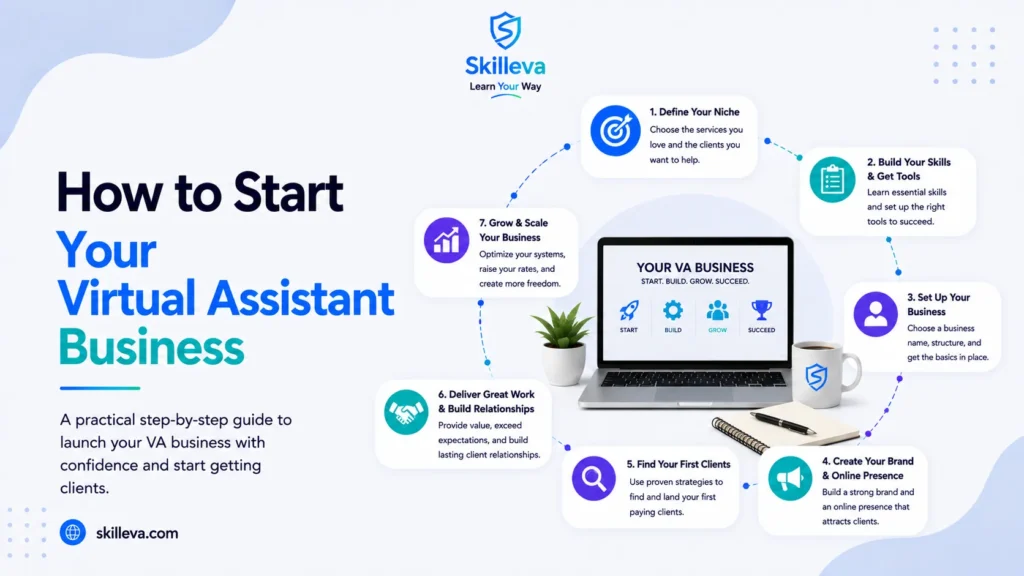
Starting a successful virtual assistant business doesn’t happen overnight. The most sustainable businesses are built through consistent learning, practical experience, and a commitment to solving real business problems.
Follow this roadmap to build a strong foundation.
Step 1: Choose a Niche
Review the 50 business ideas in this guide and select one or two areas that align with your interests, existing skills, and long-term goals.
Remember:
You don’t have to master everything.
You only need to become highly valuable in one area.
Step 2: Learn the Required Skills
Identify the knowledge and tools needed for your chosen niche.
For example:
An SEO VA should understand:
- Keyword research
- On-page SEO
- Search Console
- Content optimization
A Project Management VA should understand:
- Task management
- Team coordination
- Workflow documentation
- Project tracking tools
Investing in learning early will save you countless hours later.
Step 3: Master the Right Tools
Most virtual assistants use a combination of:
Productivity
- Google Workspace
- Microsoft 365
- Notion
Communication
- Slack
- Zoom
- Microsoft Teams
Project Management
- ClickUp
- Asana
- Trello
- Monday.com
Marketing
- Canva
- Mailchimp
- Buffer
Automation
- Zapier
- Make
- Pabbly Connect
AI
- ChatGPT
- Claude
- Gemini
You don’t need to learn every platform immediately. Focus on the tools most relevant to your chosen specialization.
Step 4: Build a Portfolio
Clients want evidence that you can deliver.
Your portfolio may include:
- Sample projects
- Case studies
- SOPs
- Workflow diagrams
- Content samples
- Marketing campaigns
- Automation examples
If you’re just starting, create practice projects that demonstrate your abilities.
Step 5: Define Your Services
Avoid advertising yourself as someone who can do everything.
Instead, clearly define:
- Who you help
- What services you offer
- The problems you solve
- The outcomes clients can expect
Clarity makes marketing much easier.
Step 6: Set Your Pricing
Choose a pricing model that reflects your experience and the value you provide.
As your skills and confidence grow, review your pricing regularly instead of keeping the same rates indefinitely.
Step 7: Find Your First Clients
Common ways to find clients include:
- Freelance platforms
- Personal referrals
- Networking communities
- Professional associations
- Business owners in your existing network
- Content marketing
Consistency matters more than trying every platform at once.
Step 8: Deliver Exceptional Service
Satisfied clients become your best marketers.
Aim to:
- Communicate clearly.
- Meet deadlines.
- Be proactive.
- Solve problems.
- Look for opportunities to improve your client’s business.
Exceptional service often leads to repeat work and referrals.
Step 9: Build Systems
As your client list grows, document your processes.
Create:
- Standard Operating Procedures (SOPs)
- Checklists
- Templates
- Client onboarding documents
- Reporting systems
Systems improve consistency and prepare your business for future growth.
Step 10: Scale Strategically
Once demand exceeds your available time, consider:
- Hiring subcontractors
- Expanding your services
- Building a niche agency
- Creating digital products
- Offering consulting
- Launching training programs
Scaling is about increasing impact—not simply working longer hours.
Frequently Asked Questions

Can I become a virtual assistant with no experience?
Yes. Many successful virtual assistants begin by offering services based on skills they already use in school, employment, volunteering, or personal projects. Focus on learning continuously and building a strong portfolio.
What skills are most important?
Strong communication, organization, time management, problem-solving, digital literacy, and a willingness to learn new tools are valuable across almost every VA niche.
Do I need a degree?
No. While certain industries may require specialized knowledge, many clients prioritize practical skills, professionalism, and proven results over formal qualifications.
Should I specialize immediately?
Not necessarily. Starting as a general VA can help you discover the type of work you enjoy. As you gain experience, specializing often leads to stronger positioning and higher earning potential.
Can AI replace virtual assistants?
AI can automate repetitive tasks, but businesses still need professionals who can think critically, make decisions, manage relationships, and adapt technology to real-world situations. Learning how to work alongside AI is likely to become an important competitive advantage.
Which industries hire the most virtual assistants?
Demand exists across many sectors, including real estate, healthcare, legal services, marketing, e-commerce, consulting, education, finance, and technology.
Can I build a business instead of freelancing?
Absolutely. Many virtual assistants eventually expand into agencies, consulting firms, training businesses, or software-enabled service companies.
VA Opportunities
The virtual assistant industry offers far more opportunities than many people realize.
Whether you’re interested in administrative support, digital marketing, bookkeeping, project management, AI automation, or industry-specific services, there is a growing demand for professionals who can help businesses operate more efficiently.
The 50 virtual assistant business ideas explored in this guide demonstrate that there is no single path to success. Some professionals thrive as general virtual assistants, while others build highly specialized careers serving a specific industry or mastering a particular skill.
If you’re still deciding which path to pursue, we recommend reading our comprehensive guide to Digital Skills That Will Be in High Demand. It will help you understand how virtual assistant services fit into the broader digital economy and identify the skills that offer the greatest long-term career opportunities.
The most successful virtual assistants share a few common habits:
- They commit to continuous learning.
- They solve real business problems.
- They focus on delivering measurable value.
- They build systems instead of relying solely on hard work.
- They embrace technology while strengthening the uniquely human skills that businesses will always need.
Start with one niche, become exceptionally good at it, and continue refining your expertise over time. As your confidence, experience, and reputation grow, so will your opportunities to increase your income, expand your services, and build a business that supports your long-term goals.
The journey doesn’t require perfection; it requires consistent progress.
Every successful virtual assistant started with a first client, a willingness to learn, and the decision to begin. Yours can start today.

Caleb is a Digital Operations Specialist who helps professionals and businesses streamline operations, optimize workflows, improve systems, and leverage AI and automation for growth and efficiency.
